

Presented by iQHAWE Magazine
Back to the Future – Remembering the Road to 2026
26 JUNE 2026
10h00 – 17h00
Remembering the Road to Freedom

How Do We Remember Freedom in 2026?
Back to the Future – Remembering the Road to 2026
Remembering the Road to Freedom is a Day 3 Creative Week programme that moves from remembrance into reimagining.
Presented as part of Basha Uhuru’s 2026 commemoration of 50 Years of Youth Activism & Creative Freedom, the programme brings together creatives, cultural workers, media voices, artists, entrepreneurs and young leaders to ask what freedom looks like today — and what it should look like over the next 30 years.
Through intergenerational conversations, youth assemblies, creative interventions, performance and practical workshops, the day explores democracy, womanhood, youth activism, creative entrepreneurship and collective futures.
Grounded in the legacies of the women of 1956 and the youth of 1976, the programme challenges participants to imagine new possibilities for freedom and consider their role in shaping South Africa’s future cultural landscape.
Free to Attend — RSVP Essential
How Do We Remember Freedom in 2026?
Freedom cannot only be remembered.
It has to be questioned, practised, protected and reimagined.
This programme asks young creatives and cultural workers to reflect on the histories that shaped South Africa, while building language, tools and relationships for the future.
The day moves between memory and action — from archival reflection and intergenerational dialogue to youth-led conversation, creative participation and practical skills-building.
Why This Programme Matters
Basha Uhuru 2026 commemorates 50 Years of Youth Activism & Creative Freedom.
Remembering the Road to Freedom asks what that legacy means now.
It creates space for young creatives and cultural workers to reflect on the past while building practical tools for the future. It connects democracy, culture, gender, youth activism and creative work as part of one unfinished freedom story.
This is not a passive commemoration.
It is a space to remember, question, participate and imagine forward.
Presented by iQHAWE Magazine
iQHAWE Magazine is an editorial platform and women-led media agency celebrating Africa’s creative heroes.
Dedicated to showcasing emerging and underrepresented creative communities, iQHAWE bridges the gap between creatives and their industries through storytelling, cultural insight and audience-centred media work.
At its core, iQHAWE is by and for youth creative culture.
Programme
Details
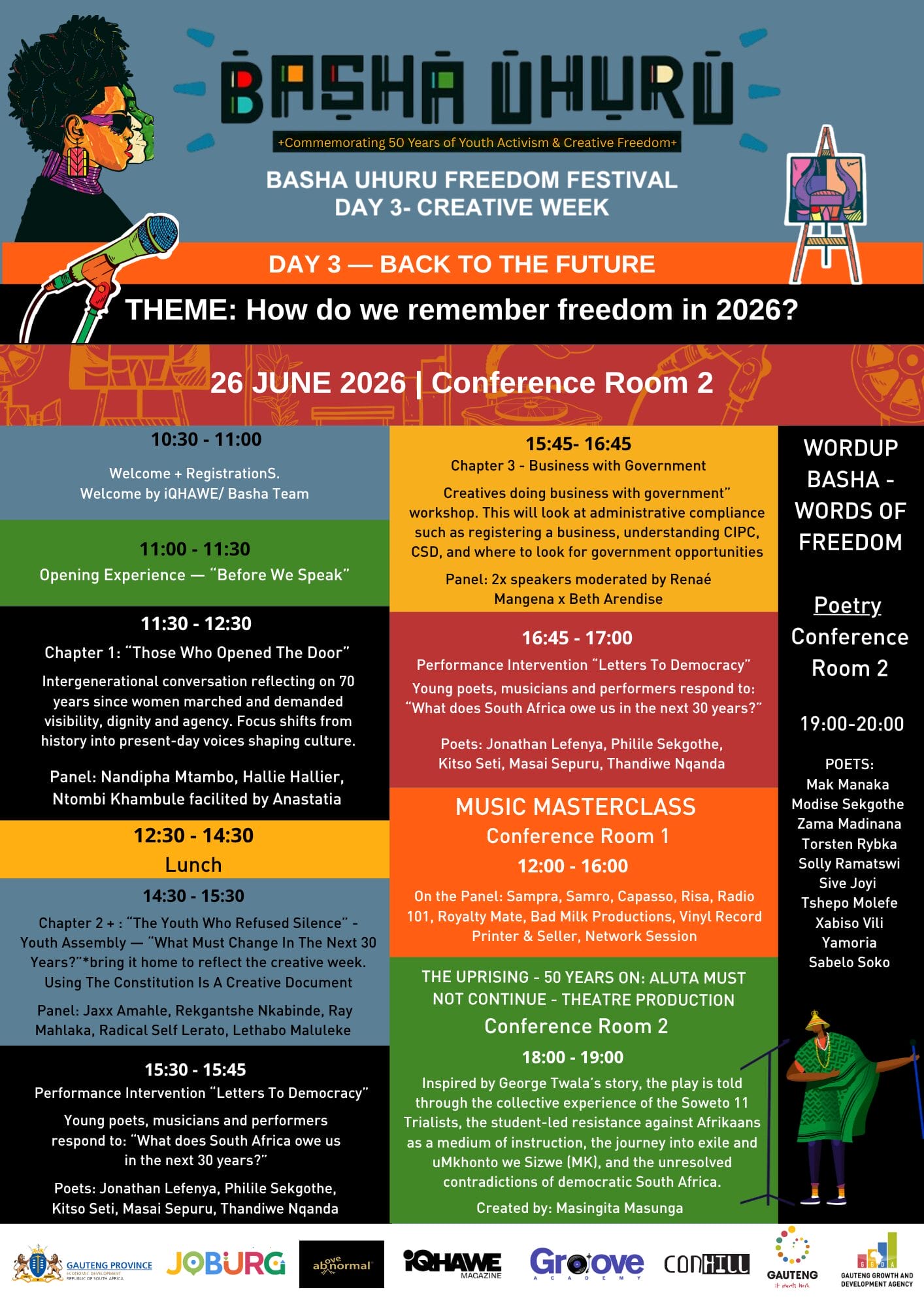
Chapter 1: Those Who Opened the Door
Those Who Opened the Door is an intergenerational conversation reflecting on 70 years since women marched and demanded visibility, dignity and agency.
The session moves from historic memory into the present, asking how women continue to shape culture, leadership, creative work and public life.
Nandipha Mntambo
Nandipha Mntambo is a Johannesburg-based artist working across sculpture, photography, video and mixed media. Her work is known for its engagement with the human body, gender, identity, performance and the relationship between humans and animals.
She won the Standard Bank Young Artist Award for Visual Art in 2011 and has exhibited widely in South Africa and internationally.
Hallie Haller
Hallie Haller is a South African film director, media artist and creative entrepreneur whose work explores technology, intimacy, the body and future-facing African culture.
Their visual style draws on movement, raw performance and symbolic, surreal aesthetics. Hallie is also a co-founder of Girls in Film South Africa.
Ntombi Khambule
Ntombi Khambule is a cultural operator and systems builder focused on strengthening African fashion and creative industries through business infrastructure, ecosystem development and institution-building.
She is the founder of the African Fashion Guild and has worked across culture, business and creative industry strategy.
Chapter 2: The Youth Who Refused Silence
The Youth Who Refused Silence is a youth assembly asking:
What must change in the next 30 years?
Reflecting on the spirit of 1976, the session explores what youth resistance looks like now — from protest and organising to TikTok, independent publishing, digital protest and cultural organising.
The conversation also asks how the Constitution can be understood as a creative document, and how young people can use culture to imagine the future.
Palesa Magwanye
Palesa Magwanye is a broadcaster, presenter, voice artist, writer and theatre practitioner whose work sits at the intersection of media, storytelling, youth engagement and public discourse.
She hosts Breaking Ground, a current affairs and student politics talk show that creates space for conversations on leadership, governance, youth participation, social justice and contemporary issues affecting South Africans.
Lethabo Maluke
Lethabo Maluke is a Johannesburg-based content creator, youth advocate and media personality known for sharp social commentary and authentic storytelling.
With experience across brands, organisations and youth-focused campaigns, he speaks directly to the next generation through culture, conversation and socially aware media work.
Valerie Makgetlaneng
Valerie Makgetlaneng is a broadcaster, producer, lecturer and youth culture storyteller.
As a multi-award-winning breakfast presenter at VOW 88.1, she is known for her authentic energy and engaging conversations. Her work spans television, radio and digital media, with a strong focus on representation, storytelling and youth voices.
Lerato Mokhere
Lerato Mokhere is a radio producer and podcaster who uses her social media platforms to talk about history and social issues.
Through her podcast The Ellipsis Podcast, Lerato explores the stories that shape society, from the past through the present and encourages her listeners to imagine a liberated future.
Performance Interventions: Letters to Democracy
Letters to Democracy creates space for young poets, musicians and performers to respond to the question:
What does South Africa owe us in the next 30 years?
These moments turn civic reflection into artistic response, carrying the programme’s themes through voice, performance and imagination.
Jonathan Lefenya
Jonathan Lefenya is an award-winning poet, writer, performer and Current State of Poetry alumnus. His work explores memory, language, belonging and the intersections between image and meaning.
His debut poetry zine, (in)tangible, was illustrated by Kyle Kemink, and his writing has appeared in several publications and arts platforms. As a performance poet, he has developed and performed in poetry theatre productions including Leru La Mahlomola, Uthando Ngumuthi, The Four Horsemen and Scarecrow.
Philile Sekgothe
Philile Sekgothe is a Johannesburg-based published poet, performance artist, music journalist and care worker.
Her work explores creativity, spiritual inquiry, care, selfhood, wild-womanhood and Godhood. Her practice moves across page, stage, sound and performance art, creating immersive experiences rooted in individual and collective healing.
Chapter 3: Business with Government
Business with Government is a practical workshop for creatives who want to understand how to work with government systems.
The session looks at administrative compliance, business registration, CIPC, CSD and where creatives can look for government opportunities.
This is a capacity-building session designed to help creative entrepreneurs move with more confidence in formal systems.
Beth Arendse
Beth Arendse is a creative economy strategist, innovation leader and CEO of Business and Arts South Africa.
With more than 25 years of experience across the creative, policy and innovation sectors, she works at the intersection of business, culture and economic development to unlock new opportunities for the African creative economy.
She previously served on South Africa’s Presidential Commission on the Fourth Industrial Revolution and is a member of the National Advisory Council on Innovation. She is also the founder of the SA Creative Industries Incubator, which supports township-based creative entrepreneurs and digital skills development.